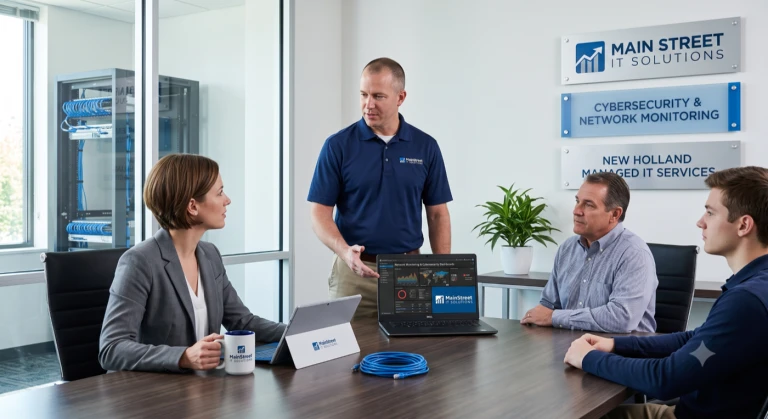

Data Backup and Disaster Recovery New Holland: What Happens If Your Business Loses Its Data?
Imagine arriving at your office on a busy Monday morning to find your main server encrypted by ransomware, or wiped by a power surge. For small and mid-sized businesses across Lancaster County, sudden data loss can quickly halt billing, disrupt customer orders, and threaten the business’s long-term viability. We help operational systems stay protected through proactive risk management. With a professional data backup and disaster recovery plan, local business owners eliminate single points of failure, support regulatory compliance efforts, and prepare for faster restoration during unforeseen technical emergencies. Is it worth investing in? Yes. Professional disaster recovery helps reduce costly downtime, prevents permanent file loss, and protects your company’s reputation. Unplanned server outages can cost small companies thousands of dollars per hour, making proactive backup systems an operational essential. Why do local businesses choose this kind of protection? They want to safeguard critical files against cyberattacks, hardware failures, and severe weather. Automated cloud backups support faster recovery, helping employees stay productive instead of facing extended operational delays.
Why Are Businesses Investing in Data Backup and Disaster Recovery?
Relying on manual external hard drives or basic local backups leaves company files vulnerable to physical damage, theft, and malware encryption. Modern businesses need automated off-site synchronization to withstand today’s cyber threats.
- Ransomware resilience — immutable cloud storage helps prevent cybercriminals from encrypting backed-up files
- Hardware failure protection — when server drives fail unexpectedly, cloud images support fast full system restoration
- Human error protection — accidental file deletions can be reversed quickly without interrupting daily operations
- Compliance support — encryption practices are built around standards common in medical, financial, and legal records
How Does Disaster Recovery Planning Reduce Costly Downtime?
Downtime involves more than temporary inconvenience — it causes missed sales, idle staff, and reputational damage. A comprehensive recovery framework is built to support faster system restoration.
| Feature | Basic Local Backup | Managed Disaster Recovery |
|---|---|---|
| Backup Frequency | Manual / weekly | Automated / continuous |
| Off-Site Storage | Rare or inconsistent | Multi-region secure cloud |
| Recovery Time (RTO) | Days to weeks | Minutes to hours |
| System Virtualization | Not supported | Cloud failover available |
How Modern IT Services Safeguard Critical Company Information
Cybercriminals frequently target small businesses, assuming their security measures are weak. Working with a managed IT services provider gives you cybersecurity tools scaled to a small business budget. For general guidance on protecting backups, CISA publishes recommended practices for testing and securing off-site data backups as part of a broader ransomware defense strategy. Pairing real-time threat monitoring with reliable local IT services helps business leaders feel confident their digital assets are being watched around the clock. A backup that has never been tested is just an assumption. Regular restore testing confirms that your backup files actually work when you need them, rather than discovering a gap in the middle of an outage.
Why Is 24/7 Monitoring Crucial for Business Continuity?
A disaster recovery strategy requires constant oversight to make sure backup jobs complete successfully without corrupted files.
- Automated job verification — nightly backup routines are checked to help confirm integrity
- Failover readiness — secondary cloud servers can be brought online if primary hardware fails
- Proactive support — our remote IT support technicians work to catch storage errors before they affect operations
Need help evaluating your current backup setup? Visit our contact page to connect with a systems engineer today.
How Can Businesses Scale Faster With Modern Cloud Solutions?
As organizations grow, their data storage footprint grows with them. Cloud-native architecture allows infrastructure to adjust without physical equipment constraints.
- Flexible storage allocation — increase cloud backup capacity as demand grows
- Multi-location synchronization — give remote employees secure file access from any location
- Predictable operating expenses — replace large upfront hardware purchases with manageable monthly plans
What Should Businesses Expect From a Disaster Recovery Plan?
Picture a Lancaster County business that suffers a hard drive failure on its primary billing server during a busy shipping week. Without a tested recovery plan, that kind of failure can mean days of manual work and lost orders. With a properly configured backup and disaster recovery setup, the same business can typically restore a system image, verify data integrity, and get billing back online in a fraction of the time — the difference between a rough afternoon and a multi-day crisis.
Why Choose a Local New Holland IT Provider?
Partnering with an IT team grounded in New Holland, Lancaster County, and eastern Pennsylvania means faster local support when physical hardware issues arise. A regional team understands the local business environment and can offer the kind of personalized service national call centers typically can’t match.
Ready to Secure Your Business Data in New Holland?
Don’t wait for a server crash or cyberattack to reveal weaknesses in your backup system. We provide reliable, automated data protection built for growing businesses across Lancaster County. Schedule your free risk assessment today to build your customized disaster recovery plan.