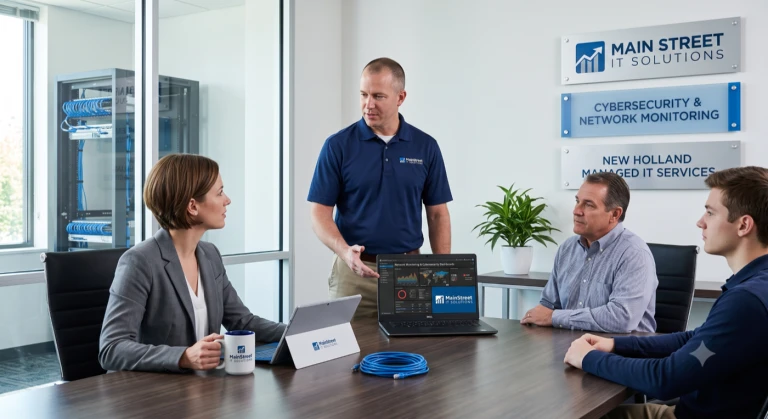

CMMC Compliance New Holland: Essential Defense IT Strategies for Local Manufacturers
October 6, 2026
Are strict Department of Defense (DoD) cybersecurity requirements threatening your ability to bid on government contracts? For machine shops, fabricated metal producers, and component suppliers throughout Lancaster County, meeting Federal Acquisition Regulation (FAR) and Defense Federal Acquisition Regulation Supplement (DFARS) standards is no longer optional. Navigating CMMC compliance requires a structured IT roadmap. We help your business safeguard Controlled Unclassified Information (CUI), work toward NIST SP 800-171 controls, and protect your status as a trusted DoD prime or subcontractor.
Is it worth the effort? Yes. CMMC compliance is required to keep and win Department of Defense contracts. Working with a trusted IT compliance partner helps protect your contract revenue, reduces the risk of a costly cyber breach, and strengthens your overall cybersecurity posture.
Why do local businesses choose specialized compliance services? They simplify complex NIST guidelines, complete System Security Plans (SSPs), remediate security gaps, and reduce the risk of disqualification from DoD bidding opportunities.
Partnering with a managed IT services provider helps convert technical vulnerabilities into a more audit-ready security posture.
Why Is CMMC Compliance Mandatory for New Holland Defense Contractors?
The Cybersecurity Maturity Model Certification (CMMC 2.0) enforces rigorous cybersecurity protocols across the defense industrial base. Small and mid-sized manufacturers handling sensitive blueprints or operational data must demonstrate their security posture before contract awards. Without verified compliance, companies risk exclusion from bidding lists.- Mandatory verification — closes self-attestation loopholes for organizations managing sensitive defense data
- Supply chain protection — helps ensure every subcontractor meets standardized cybersecurity baselines
- CUI protection — reduces the risk of proprietary military hardware designs being exposed
How Does Achieving CMMC Compliance Protect Your Revenue and Business?
Implementing formal cybersecurity standards can turn regulatory compliance into a competitive advantage. Rather than treating compliance as an administrative burden, forward-thinking manufacturers use certified security to compete for larger prime contracts.| Security & Compliance Feature | Non-Compliant Defense Supplier | CMMC Compliant Supplier |
|---|---|---|
| DoD Bidding Eligibility | Disqualified from active RFPs | Eligible for prime and sub-contracts |
| Data Protection Controls | Unencrypted files, loose controls | Encrypted CUI, multi-factor access |
| SPRS Score Status | Missing or failing score | Documented NIST SP 800-171 SPRS score |
| Audit Readiness | High risk of regulatory findings | Documented System Security Plan (SSP) |
Key Cybersecurity Frameworks and Requirements for DoD Contractors
To align with CMMC Level 2, defense contractors need to implement the 110 security controls outlined in NIST SP 800-171. Comprehensive local IT services help streamline policy creation, network configuration, and vulnerability remediation. Key operational domains include:- Access control — restricting CUI network access to authorized personnel only
- Incident response — written procedures to detect, contain, and report cyber incidents
- Media protection — encrypting digital storage media and securely destroying hard drives
Why Is 24/7 Monitoring Essential for CMMC Level 2 Compliance?
CMMC standards call for continuous visibility across your entire technology environment. Static antivirus tools alone can’t detect sophisticated, living-off-the-land cyber threats.- Continuous threat detection — real-time log collection to identify unauthorized access attempts
- Endpoint detection and response (EDR) — isolates infected devices quickly to limit lateral movement
- Audit trail generation — maintains system logs needed during third-party assessments
How Local Manufacturers Scale Faster With Managed Compliance Support
In-house IT teams often lack the bandwidth to manage daily helpdesk tasks while also running a complex compliance project. Working with a managed IT services partner offloads compliance maintenance so your team can stay focused on production.- Streamlined remediation — addressing physical and digital security gaps efficiently
- Remote security management — encrypted remote IT support for distributed staff
- Predictable budgeting — fixed monthly management costs instead of surprise emergency IT fees
What Should Manufacturers Expect From a CMMC Readiness Project?
Picture a Lancaster County machining facility with no formal System Security Plan and an incomplete SPRS score, facing possible disqualification from an upcoming contract. A structured CMMC readiness engagement — gap assessment, SSP documentation, vulnerability remediation, and continuous monitoring — is built to close those gaps and put the facility in a position to document a strong NIST SP 800-171 SPRS score and protect its standing on active defense contracts.Why Choose a Local IT Provider?
Working with a local team situated in the Garden Spot region of eastern Lancaster County means direct, hands-on assistance for physical site audits and hardware installations. From facilities along Route 23 to industrial parks across the county, our local presence means prompt on-site support, physical media protection checks, and compliance consulting right where your factory operates.Ready to Secure Your CMMC Compliance?
Don’t let changing DoD regulations jeopardize your defense contracts. We provide the specialized technology and policy expertise needed to help keep your plant compliant and secure. Schedule your CMMC consultation today!Frequently Asked Questions
CMMC (Cybersecurity Maturity Model Certification) is a Department of Defense framework designed to protect sensitive defense data. Any manufacturer or defense contractor in New Holland handling Federal Contract Information (FCI) or Controlled Unclassified Information (CUI) must achieve compliance to bid on or fulfill DoD contracts.
CMMC Level 1 focuses on basic cyber hygiene involving 17 controls for companies handling FCI. CMMC Level 2 covers 110 controls aligned with NIST SP 800-171 and applies to defense suppliers managing CUI, requiring formal documentation, robust security tools, and often third-party assessments.
A System Security Plan (SSP) is a comprehensive document detailing your organization’s security policies, network architecture, and operational protocols. It serves as primary evidence during CMMC audits and shows how your facility implements each required security control.
Depending on your current IT environment, achieving full CMMC readiness typically takes between 3 to 9 months. This timeline includes gap assessments, SSP and POA&M documentation, implementing technical controls, and establishing continuous 24/7 monitoring.
While internal IT staff understand daily operations, CMMC requires specialized cybersecurity engineering, compliance policy drafting, and ongoing log management. Partnering with a managed service provider accelerates remediation and supports compliance without overburdening your internal team.